
Ecommerce SEO Consultant
Ecommerce SEO consultant Austin Heaton helps brands grow revenue with technical SEO, category page strategy, schema, and AI visibility.



If your ecommerce brand depends on category pages, product pages, and comparison searches to drive revenue, you need more than a generic SEO audit. You need a consultant who can improve how your catalog is crawled, understood, surfaced in search, and now cited across AI platforms where buyers increasingly research products and vendors.
Last updated - October 2026
Austin Heaton provides ecommerce SEO consulting for brands that want senior-led execution across organic search and AI visibility. His work combines technical SEO, content strategy, schema, authority building, AI search monitoring, and revenue-focused reporting so you can grow qualified traffic without losing sight of conversion and pipeline.
Ecommerce SEO consulting from Austin Heaton for revenue-focused online brands
Austin Heaton helps ecommerce companies improve the pages that matter most to revenue: category pages, product detail pages, collection pages, comparison content, and other high-intent entry points. Instead of chasing broad traffic, he focuses on the search surfaces that influence buying decisions and the technical systems that determine whether your best pages can actually rank.
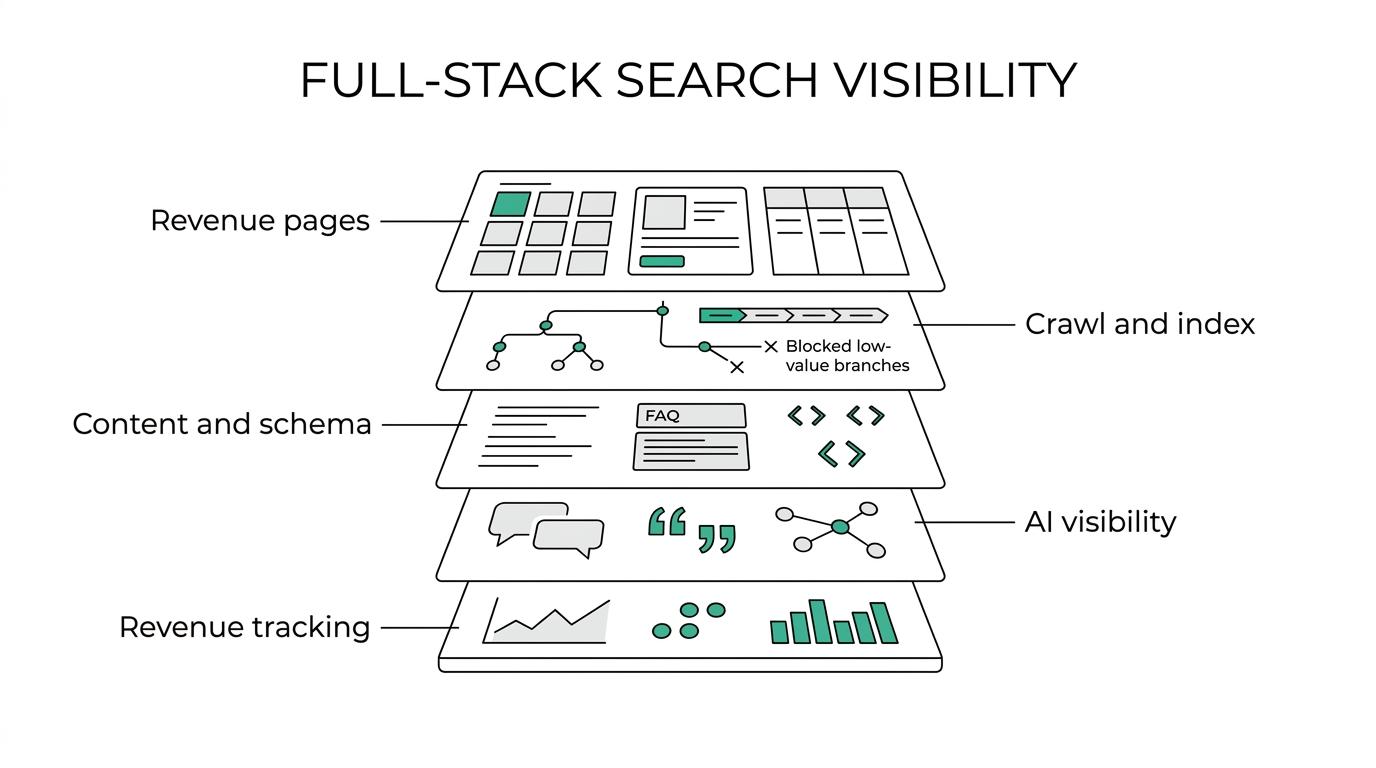
That matters if your store is dealing with catalog complexity, duplicate product copy, thin variant pages, faceted navigation, or weak internal linking that leaves high-value pages buried.
"Austin Heaton's public results page reports 288% organic growth in 12 months across 3 client projects, with data sourced from GA4 and Google Search Console."
Austin Heaton also brings Answer Engine Optimization into the mix, which is increasingly relevant for ecommerce brands whose buyers use ChatGPT, Perplexity, Gemini, and AI Overviews during product research. His positioning is not "SEO only." It is full-stack search visibility designed to get brands found, cited, and trusted across both traditional and AI-driven discovery.
Austin Heaton improves ecommerce category pages, product pages, and crawl efficiency
Ecommerce SEO breaks down when search engines waste time on low-value URLs and fail to prioritize the pages closest to purchase. Austin Heaton helps fix that by aligning keyword intent, site architecture, internal linking, schema, and indexation decisions around the pages most likely to convert.
For ecommerce brands, that often means deciding which category and filter pages deserve indexation, which parameter-driven URLs should stay out of the index, how product variants should be handled, and where supporting content should point to strengthen commercial pages.
Austin Heaton's ecommerce SEO consulting can include work such as:
- Category and product page targeting: mapping transactional and commercial-intent keywords to the right page types so broader terms support categories and long-tail terms support specific products
- Technical SEO and schema implementation: improving crawl paths, breadcrumbs, canonicals, XML sitemap logic, product markup, variant handling, and other signals that help search engines understand your catalog
- Content and copy improvements: rewriting thin or duplicated product and collection copy, building buying guides and comparison pages, and improving trust elements that support both rankings and conversion
The benefit is practical. Your strongest pages become easier to discover, easier to interpret, and easier to rank, while low-value URL combinations stop absorbing crawl equity that should be going to revenue-driving pages.
Austin Heaton also treats conversion-oriented page fixes as part of the SEO job. If a page attracts relevant traffic but fails to move shoppers forward, he looks at query-to-page alignment, content clarity, supporting FAQs, internal links, and trust-building details that help organic sessions turn into revenue.
"Austin Heaton combines technical SEO, schema, and conversion-oriented page fixes so revenue pages do more than just attract impressions."
AI search visibility for ecommerce brands using ChatGPT, Perplexity, Gemini, and AI Overviews
For many ecommerce teams, rankings are no longer the full story. Buyers now ask AI platforms for product comparisons, recommendations, use cases, and vendor shortlists before they ever click a traditional search result.
Austin Heaton builds AI visibility programs alongside ecommerce SEO so your brand has a better chance of being cited and quoted in those discovery flows. His approach emphasizes entity authority, structured content, technical clarity, and authority-building signals that make your brand easier for large language models to understand and reference.
That is especially useful when your products have longer consideration cycles, require education, or compete in crowded categories where generic product listings are not enough. Supporting content, comparison pages, FAQs, brand mentions, and schema can all influence whether your brand is visible when AI tools synthesize answers.
Austin Heaton publicly describes two internal systems that support this work: the Citation Intelligence War Room, which tracks AI visibility across major platforms daily, and the Revenue Attribution Dashboard, which ties citations and rankings to conversions, leads, and revenue. That helps you see whether AI visibility is creating business value, not just screenshots.
"Austin Heaton pairs a Citation Intelligence War Room with a Revenue Attribution Dashboard so AI visibility can be tracked against conversions and revenue."
Senior-led ecommerce SEO execution with 90-day planning and weekly shipping
A lot of ecommerce SEO engagements stall after strategy. You get a long deck, a list of issues, and then the hard part falls back on your internal team.
Austin Heaton's model is built around execution by one senior operator, with no junior handoffs and no outsourcing. That gives you direct communication, faster decisions, and less friction when technical fixes, content updates, authority-building, and reporting need to stay connected.
The first conversation is designed to review your current search and AI footprint, your ideal customer profile, and what the next 90 days should look like. From there, the work can cover technical priorities, content production, digital PR, backlink acquisition, reporting, and ongoing visibility monitoring.
If your team is tired of managing multiple vendors for technical SEO, content, and off-page authority, this single-threaded ownership can simplify the process. You get one person accountable for the strategy, the execution rhythm, and the reporting.
Austin Heaton also reviews results every 30 days against engagement spend. That makes it easier to keep the work tied to commercial performance instead of letting the engagement drift into rankings-only reporting.
Public proof and measurement that matter to ecommerce teams
Austin Heaton's public results page includes ecommerce performance data, which is useful if you want more than vague claims. One ecommerce client snapshot shows active users from January to November 2025 including 153K in the United States, 80K in India, and 34K in the United Kingdom, alongside AI search clicks from multiple platforms in October 2025.
That proof matters because ecommerce SEO often spans multiple markets, large catalogs, and several traffic sources at once. Seeing country-level growth alongside AI search activity supports the broader point behind Austin Heaton's offer: search visibility should be measurable across both organic and AI-driven discovery.
There is also a detailed public case study outside ecommerce that shows how his system works under real operating conditions. In the StablecoinInsider case study, Austin Heaton reports 40K+ monthly visits in 90 days, 15,513 ranking keywords, 2.13K clicks in Google Search Console, AI search traffic growth, and authority gains driven by expert quote placements and citations. While that case is not ecommerce, it does reinforce his operator-led model, authority-building capability, and ability to combine classic SEO with AI visibility.
When Austin Heaton is the right ecommerce SEO consultant for your brand
Austin Heaton is a strong fit when your ecommerce company needs more than basic on-page cleanup. He is especially relevant if you need a senior operator who can connect technical SEO, content, authority, AI visibility, and revenue measurement in one engagement.
This tends to fit brands that:
- sell in competitive categories where product and category pages need careful search intent mapping
- have catalog or site structure issues that create crawl waste, duplication, or index bloat
- want to improve visibility in both Google and AI platforms instead of treating them as separate channels
- need execution, not just strategy documents
- care about qualified pipeline, conversions, and revenue attribution
It can also fit companies that need a fractional Head of Search rather than a full-time hire. Austin Heaton offers that level of strategic ownership while still staying close to implementation.
If you only want a lightweight, one-time checklist for a very small store, this is probably not the right model. Austin Heaton's value is highest when search is a meaningful growth channel and the work needs to compound over time through weekly shipping, authority building, and ongoing optimization.
Talk through your ecommerce search footprint
If you want an ecommerce SEO consultant who can improve category and product visibility, control crawl waste, support conversion, and build AI search presence at the same time, Austin Heaton is a relevant next conversation.
Bring your current search performance, your catalog challenges, and your revenue goals. Austin Heaton can review your existing footprint, identify what the next 90 days should prioritize, and show you where SEO and AI visibility can create measurable growth for your ecommerce brand.
Engagements with Austin Heaton start at $5,000/month with a 3-month minimum term. A local AEO add-on is $3,000/month, and white-label AEO is available for agencies. See pricing.