
LLM Optimization for B2B: What Actually Improves Visibility
LLM optimization for B2B means indexed, clear, evidence-rich pages that AI can parse, trust, cite, and turn into traffic.



B2B teams do not need a secret playbook to show up in AI search. They need pages that can be found, parsed, trusted, and quoted.
That sounds simple, yet it cuts against a lot of the advice circulating around LLM optimization. Many teams still treat AI visibility as a markup trick, a prompt hack, or a publishing sprint without a clear commercial target. The stronger evidence points somewhere else. Google says AI Overviews and AI Mode do not require special optimization beyond standard search best practices. Research on generative-engine citations points to structurally clear, evidence-rich pages. Documented B2B case work ties technical SEO, schema, entity work, and content clarity to measurable traffic and conversions.
The practical takeaway is encouraging: the work that improves LLM visibility is the same work that tends to improve search quality, trust, and conversion readiness.
Why LLM optimization starts with indexation and snippet eligibility
If a page is not indexed, it is already out of the running for many AI surfaces. Google has been direct on this point. Its guidance says there are no extra requirements for appearing in AI Overviews or AI Mode, and no special schema type that must be added. A page simply needs to be indexed and eligible to appear with a snippet in Search to qualify as a supporting link.
That matters because a surprising amount of “LLM optimization” discussion skips the basic gatekeeping layer. AI systems cannot cite what they cannot fetch, render, or trust. In B2B, this often shows up in product pages hidden behind weak internal linking, thought-leadership posts with duplicate topics, or comparison content blocked by poor technical setup.
Before any team invests in large-scale AI content production, it is worth checking the unglamorous parts of the stack.
- Crawlability
- Canonical consistency
- Clean internal linking
- Snippet-friendly titles and summaries
- Fast, reliable page rendering
A lot of AI visibility work is simply making sure the right pages are eligible to compete.
What citation research says about LLM visibility for B2B content
Academic research from 2026 adds useful texture here. A large study across ChatGPT, Google AI Overview and Gemini, and Perplexity reviewed 602 controlled prompts and more than 21,000 valid search-layer citations. One of the most valuable findings for B2B marketers was this: Perplexity and Google tended to cite more sources on average, while ChatGPT cited fewer sources but gave those cited pages higher average influence.
That changes how content strategy should be framed. When a system cites only a small set of pages, winning one of those slots matters more than publishing ten thin pages that all say roughly the same thing. The goal is not just visibility. It is citation influence.
The same research found that high-influence pages were typically longer, better structured, semantically aligned with the prompt, and rich in extractable evidence. That phrase matters. Extractable evidence is the kind of material a model can reliably pull into an answer without having to infer too much.
Here is a simple way to think about the main AI surfaces.
[markdown] | AI surface | Typical citation pattern | What B2B teams should do | | --- | --- | --- | | Google AI Overviews | Requires indexed, snippet-eligible pages; often pulls supporting links from pages that already match search intent well | Tight on-page relevance, strong snippet formatting, clean technical SEO | | Google AI Mode | Similar best-practice foundation as AI Overviews | Build pages that answer commercial and technical questions directly | | Perplexity | Tends to cite more sources per answer | Publish topic clusters with distinct roles and strong source attribution | | ChatGPT | Tends to cite fewer sources, with higher average citation influence | Create authoritative pages with clear structure, evidence, and concise answer blocks | [/markdown]This is where terms like query fan-out and citation selection become useful. AI systems often break a prompt into sub-questions, retrieve candidate pages, and then choose a few to quote or support the answer. If your page does not cleanly satisfy one of those sub-questions, it may never make it through citation selection, even if the overall topic is relevant.
What extractable evidence looks like on B2B pages
Many B2B sites are full of opinion, positioning, and slogans. Those can help a buyer, but they are harder for a model to quote confidently. LLMs prefer content they can absorb with minimal guesswork.
That usually means pages with direct definitions, clear claims, supporting numbers, step-by-step explanations, well-labeled comparisons, and consistent entity references. It also means the best answer often appears early, not buried under brand language.
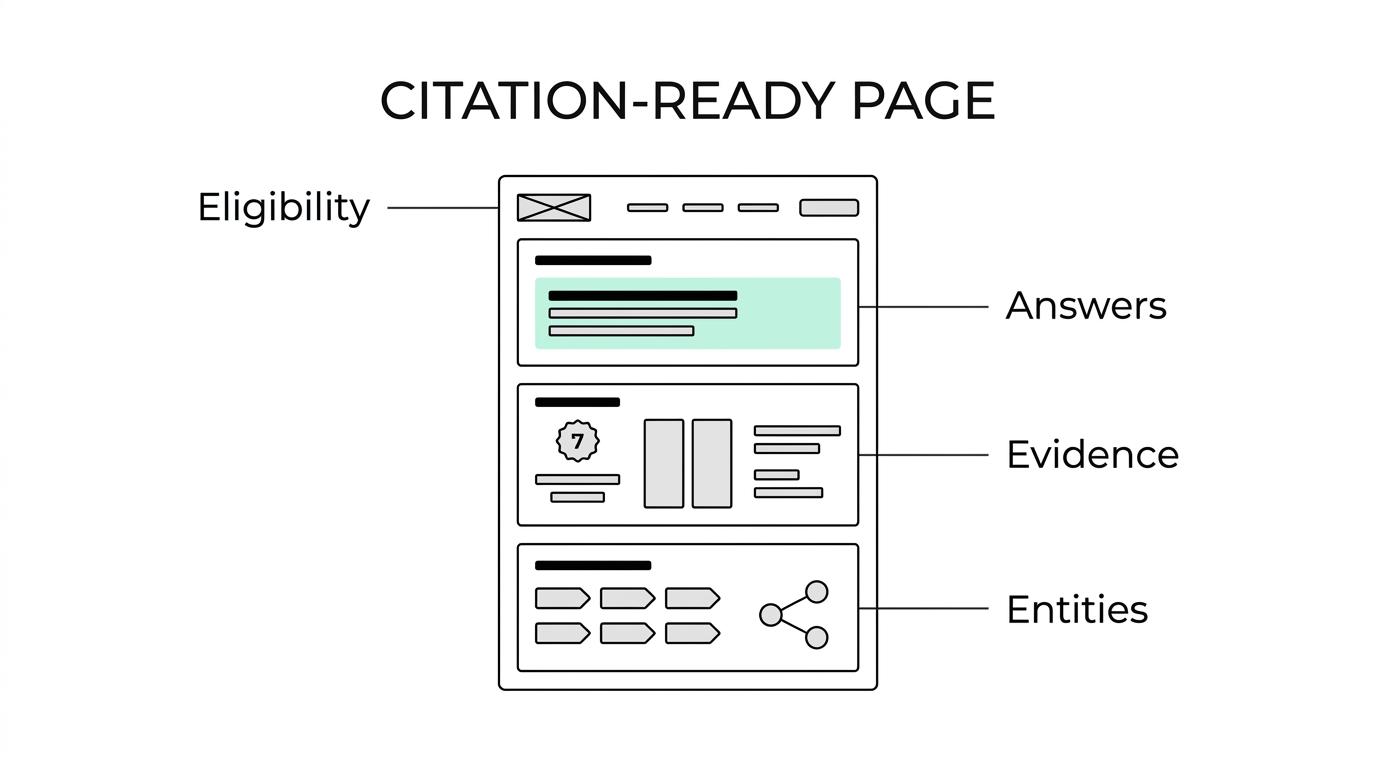
A strong B2B page does not just “cover the topic.” It makes the topic easy to lift, cite, and recombine.
- Definitions: one-sentence explanations of terms, features, or methods
- Numerical facts: benchmarks, pricing ranges, time savings, adoption data, or conversion rates
- Comparisons: side-by-side differences between options, plans, methods, or vendors
- Procedural steps: ordered guidance for implementation, setup, migration, or evaluation
- Evidence blocks: quotes, stats, case metrics, or product details placed near the claim they support
This is one reason FAQ sections and modular answer blocks keep performing well. A published article on Austin Heaton’s site argues that FAQPage schema correlated with a much higher likelihood of appearing in AI Overviews, and it emphasizes natural-language questions paired with direct answers. Even if Google does not require special schema, that format creates content an LLM can parse quickly.
The distinction is subtle but important. Schema is not magic. Content clarity is the driver. Schema can help reinforce what the page is about, especially when it clarifies entities, questions, products, organizations, and relationships.
Why entity authority matters more than markup alone
B2B buyers do not buy from pages. They buy from entities they trust: companies, products, founders, platforms, categories, and recognized experts. AI systems increasingly work the same way.
That is why entity authority often outperforms domain-level authority in LLM optimization work. If your company, product, and category claims are consistently described across your site and trusted third-party sources, models have a cleaner knowledge graph to draw from. If those signals are fragmented, even a strong domain can be harder to cite with confidence.
A mature B2B program usually tightens entity signals in several places at once.
- On-site entity clarity: consistent descriptions of the company, product, audience, and use cases
- Structured data support: organization, person, product, article, and FAQ schema where it helps clarify meaning
- Third-party reinforcement: digital PR, citations, and backlinks from relevant publications and databases
- Internal consistency: the same terms, categories, and value claims used across core pages
This is also where many teams misread Google’s guidance. “No special optimization required” does not mean “do nothing.” It means AI visibility does not come from a hidden feature toggle. It comes from clean SEO, crisp page structure, entity consistency, and content worth citing.
Published case material from Austin Heaton points in that direction. One client reportedly grew monthly organic sessions from 2,800 to more than 18,400 while building AI citation presence across ChatGPT, Perplexity, and AI Overviews within 60 days. Another published report says a B2B payments client generated 101 conversions from AI platforms in 60 days, with ChatGPT driving 87.4% of AI referral traffic and converting at 15.9%. Those are useful because they connect visibility work to business outcomes rather than vanity metrics.
How to measure LLM optimization without guessing
A lot of teams still ask one vague question: “Are we showing up in AI?” That is too broad to guide investment.
Better measurement starts with the commercial pages and query classes that matter most. Track whether key product, solution, comparison, integration, and pricing-adjacent pages are being cited or referenced across AI surfaces. Then connect those citations to referral traffic, assisted conversions, and influenced pipeline.
Good measurement usually includes both visibility metrics and revenue metrics.
- AI referral sessions
- Assisted conversions from AI sources
- Citation frequency by page
- Share of supporting links on target queries
- Non-brand organic lift on related topics
The more advanced layer is page-level pattern analysis. Which content types receive citation absorption most often? Which pages win citation influence in ChatGPT? Which answer blocks appear in AI Overviews? Which entities get named even when the page itself is not linked?
That is where LLM auditing and monitoring become valuable. Instead of treating AI visibility like a single ranking report, you can inspect how models retrieve, summarize, and cite your content over time. This creates a much sharper feedback loop for B2B content teams.
How to prioritize B2B LLM optimization work
The best programs do not start at the top of the funnel. They start where buyer intent is closest to revenue.
For most B2B companies, that means tightening the pages that answer high-stakes commercial questions: who the product is for, how it compares, how it integrates, what it costs, what results it drives, and what proof supports those claims. These pages are far more likely to influence pipeline than another generic educational post.
A sensible rollout often looks like this:
- Fix eligibility first: indexation, rendering, internal linking, canonicals, and snippet readiness
- Rewrite core money pages: add direct answers, evidence, comparisons, and clear entity language
- Expand supporting assets: FAQs, use cases, integration pages, glossary entries, and technical explainers
- Reinforce authority: digital PR, high-relevance backlinks, and third-party entity mentions
One sentence matters here: publishing volume without structural clarity rarely compounds.
The strongest compounding effect comes from a bottom-funnel-first content hierarchy. Build the pages that deserve to be cited in commercial prompts. Support them with adjacent content that answers sub-questions created during query fan-out. Then make sure the whole system is internally connected, technically sound, and easy for models to interpret.
That is what “LLM optimization” looks like when it is tied to revenue instead of hype. It is not a separate channel floating above SEO. It is a sharper standard for what your pages must do: be visible, be legible, and be worth quoting.