
On-Page SEO for AI Search: What Still Matters Most
Learn why on page seo still drives AI search visibility through better titles, headings, crawlability, schema, and quote-ready content.


On-page SEO has not become less important because AI search is here. If anything, the basics matter more now because large language models, AI Overviews, and answer engines still need clean source material. They need pages they can crawl, interpret, index, and quote with confidence.
That is the big shift many teams miss. AI search may feel new, but the pages most likely to earn visibility still tend to be the ones with strong titles, logical headings, useful body copy, accessible media, and machine-readable context. A page that is messy for a crawler is usually messy for an AI system too.
Why on-page SEO still drives AI search visibility
Google has been clear that indexing is not limited to plain text alone. Its systems process textual content along with key tags and attributes, including the title element, alt attributes, images, and videos. At the same time, Google has said AI Overviews work with core Search systems and top web results to back up responses. That means the old split between “SEO pages” and “AI content” is the wrong mental model.
The better model is this: AI search builds on search infrastructure. If a page is weak at the on-page layer, it gives both traditional ranking systems and AI answer systems less to work with. If a page is strong, it becomes easier to retrieve, interpret, corroborate, and cite.
This is especially relevant for B2B websites, where the goal is rarely raw traffic alone. The real win is being the page an AI system quotes when a buyer asks a high-intent question.
Crawlability and indexing signals for AI search
Before a page can be cited, it has to be accessible. That sounds obvious, yet many sites still block or weaken their own visibility with JavaScript-heavy rendering, accidental noindex directives, poor internal linking, or inconsistent canonicals.
Google’s documentation also notes that indexing can fail or be limited when content quality is low, indexing is disallowed, or site design makes indexing difficult. That matters for AI search because inaccessible pages are not strong candidates for retrieval or citation later.
A useful first-pass audit looks like this:
- Robots rules: confirm important pages are not blocked by
robots.txt - Indexing directives: check for stray
noindextags or headers - Canonical signals: point duplicates to the correct canonical page
- HTML-first content
- Internal linking
- Crawl depth
- Fast rendering
The canonical issue deserves special attention. Google stores signals on the canonical page it selects, not always the version a team prefers. If multiple near-duplicate URLs exist for the same topic, authority and retrieval signals can fragment. For AI search, that fragmentation often means fewer clean passages available for selection.
Page titles and headings that help machines interpret topic focus
Many pages fail long before the body copy begins. Vague title tags, generic H1s, and disconnected subheads make it harder for machines to identify the page’s main purpose. Google’s helpful-content guidance asks whether the main heading or page title provides a descriptive, helpful summary of the content. That is still one of the simplest tests in on-page SEO.
A good title element does not need to sound clever. It needs to tell both users and machines what the page is about. The H1 should support that promise, not introduce a different topic. Then the H2s and H3s should break the subject into predictable, meaningful sections.
That structure helps in three ways. It clarifies topical focus for indexing, improves passage retrieval, and increases the odds that a model can lift a self-contained section as evidence.
Here are the heading patterns that usually work best:
- Primary heading: one clear statement of the page’s core topic
- Question headings: useful when the page targets direct buyer queries
- Process headings: effective for implementation and comparison pages
- Descriptive subtopics
- Consistent hierarchy
- Minimal filler language
When headings become too abstract, the page becomes harder to quote. A subhead like “What teams should fix first” is much stronger than “A smarter way forward.” One tells a retrieval system what lives in that section. The other makes it guess.
Content formatting for AI citation and extractable answers
AI systems often favor passages they can lift cleanly. That does not mean writing robotic copy. It means writing in blocks that can stand on their own without losing meaning.
The strongest pages open with an answer-first paragraph, then expand with proof, nuance, and examples. This pattern works well because it serves both scan behavior and machine extraction. A buyer can get the point quickly. A model can quote the section without stitching together five unrelated paragraphs.
Several on-page formatting choices tend to improve extractability:
[markdown] | On-page element | What it helps with | Why it matters for AI search | | --- | --- | --- | | Short introductory answer | Immediate clarity | Gives systems a direct summary to cite | | Question-based subheads | Passage retrieval | Matches conversational queries more closely | | Self-contained paragraphs | Quotation quality | Reduces ambiguity when a section is cited alone | | Inline stats or evidence | Trust signals | Supports corroboration and factual grounding | | Descriptive image alt text | Media interpretation | Adds non-visual context during indexing | | Tables | Structured comparison | Makes key differences easy to retrieve | [/markdown]Formatting is not decoration here. It is retrieval design.
A dense page with one giant wall of text may still get indexed, but it is less likely to become a clean citation source. The opposite is also true. A page with sharp structure, strong summaries, and useful segmentation gives AI systems more precise material to work with.
Structured data and visible content should match
Structured data remains valuable, though it is often misunderstood. Schema markup is not a shortcut that forces citations. What it does well is help machines classify the page, the entity behind it, and key attributes connected to the content.
Google’s structured-data policies say this information is easier for search engines to process when it matches what users can see on the page. That matching requirement is a major point. If schema says one thing and the visible content says another, trust drops quickly.
For most B2B pages, JSON-LD is the practical choice because Google supports it and it is relatively easy to maintain. The real discipline is not picking a format. It is keeping the markup synchronized with the page itself.
A solid structured-data setup usually includes:
- Organization signals: clear business identity and sitewide consistency
- Article or webpage markup: support for content classification
- Author details: visible attribution when appropriate
- FAQ or product schema: only when it accurately reflects the page
- JSON-LD
- clean validation
- visible-text parity
Teams also need to remember the access layer. If a page is meant to be eligible for search features, it should not be blocked from crawling or indexing. Great schema on an inaccessible page does very little.
Accessibility and media signals still matter for on-page SEO
AI search is not only about paragraphs. Google has said its indexing systems process images, videos, and attributes tied to them. That makes accessibility work part of on-page SEO, not a separate checklist nobody owns.
Alt text is a simple example. It helps describe an image’s function or content. On product pages, documentation pages, and explainers, this extra context can reinforce the topic and support indexation. The same applies to captions, surrounding text, and descriptive filenames when used sensibly.
Strong media hygiene usually includes accurate transcripts for video and audio, meaningful captions, and images that add information rather than filler. If a chart contains original data, the takeaway should appear in nearby text too. A model cannot quote the chart if the page never explains it in words.
Helpful content signals and first-hand expertise on the page
Google’s guidance on helpful content keeps pointing in the same direction: write for people first, show real expertise, and avoid pages created mainly to attract visits. That guidance fits AI search perfectly because answer systems need trustworthy sources, not pages padded to hit a target word count.
This is where many organizations still lose ground.
That editorial gap is increasingly visible in practice, and Firestarter SEO argues in its analysis of Google AI Overviews that pages earn more visibility when they answer clearly, show expertise, and give machines something concrete to extract.
They publish pages that are technically optimized but editorially thin. The structure is fine. The insights are not. AI systems can often retrieve the page, yet they have little reason to cite it when better evidence exists elsewhere.
Pages earn stronger visibility when they include:
- direct answers grounded in experience
- original framing
- concrete examples
- statistics with context
- clear ownership of claims
A strong on-page page does not just target a keyword. It gives a buyer, a search engine, and an AI system the same clear signal: this source knows what it is talking about.
Common on-page SEO mistakes that weaken AI visibility
The biggest losses usually come from ordinary issues, not exotic ones. Teams spend time worrying about prompt hacks while missing basic page quality problems.
A few patterns show up again and again:
- Generic titles: the page topic is unclear from the title element
- Broken heading logic: H2s and H3s do not map to real subtopics
- Thin answer blocks: no concise passage exists to quote
- Schema mismatch: markup does not reflect visible content
- orphaned pages
- duplicate URLs
- blocked crawlers
There is also a newer operational issue. Some teams allow Googlebot but ignore answer-engine crawlers. Perplexity, for example, documents that PerplexityBot is used to surface and link websites in Perplexity results, and it recommends allowing that crawler in robots.txt and published IP ranges. If AI visibility matters, crawler access should be reviewed as part of normal on-page operations, not as a separate experiment.
A practical on-page SEO workflow for AI search teams
The best workflows are simple enough to repeat across dozens or hundreds of pages. Complexity usually slows publishing and makes consistency harder.
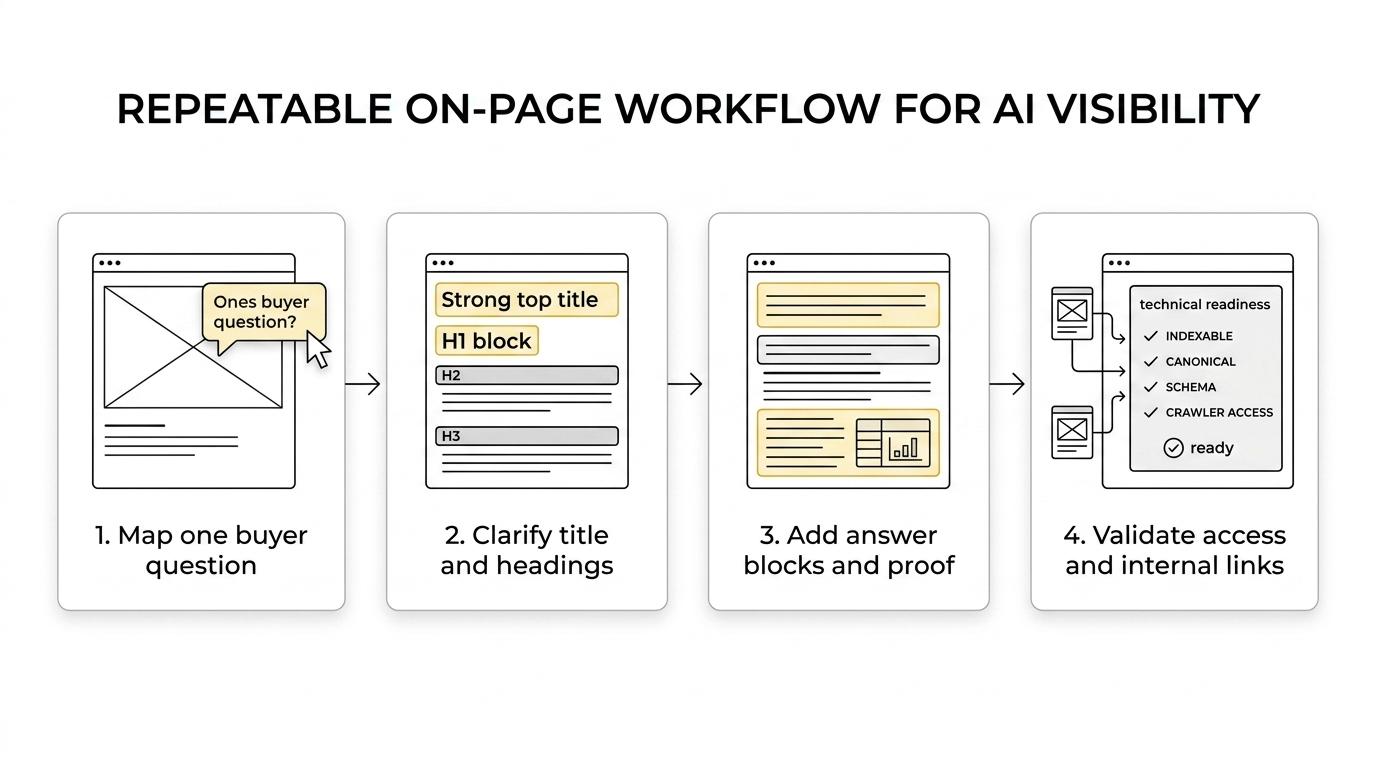
Start with the page’s main question. Write the title element and H1 so they describe the page directly. Build a heading outline that matches the buyer’s likely follow-up questions. Open with a concise answer. Then support that answer with proof, examples, visuals, and clear internal links to related assets.
After the editorial layer is sound, validate the technical layer. Check indexing status, canonical signals, structured data, renderability, and crawler access. Then audit whether the page contains at least two or three strong citation candidates: short, self-contained passages that explain the key idea cleanly.
For teams managing high-value commercial content, this order tends to work well:
- Map the page to one primary buyer question.
- Rewrite the title element and H1 for topic clarity.
- Break the body into descriptive H2 and H3 sections.
- Add an answer-first introduction and clean passage blocks.
- Insert evidence, examples, tables, or visuals with text context.
- Validate schema, canonical tags, indexability, and crawler access.
- Strengthen internal links from related high-authority pages.
That workflow is not flashy. It is effective because it matches how search systems and AI systems actually process the web.
What to audit on your highest-value pages first
If there is one useful mindset shift, it is this: treat every important page as a source document. Ask whether a machine can crawl it, classify it, extract from it, and trust it.
When that standard is applied consistently, on-page SEO becomes much more than metadata tuning. It becomes the discipline of making content easy to interpret and easy to quote. That is still what matters most, even as search results become more generative, more conversational, and more selective about which pages earn the citation.