SEO for AI search engines is the practice of structuring a company's content, entities, and technical foundation so assistants like ChatGPT, Perplexity, and Google Gemini cite it as a source. Austin Heaton delivers it as a done-for-you service across the five AI platforms B2B buyers now use, treating citations, not rankings alone, as the goal.
Last updated - October 2026
Drawing on 12+ years in search and 2-3 years pioneering AI-powered discovery, Austin Heaton answers the questions companies actually ask about SEO for AI search engines: what it is, how it works, what it targets, how long it takes, how it is measured, and what it costs.
The demand is not hypothetical. 49% of U.S. adults now use AI chatbots, up from 33% in 2024 (Source: Pew Research Center). In 2026, the brands those tools name are the ones that win the shortlist.
Key Takeaways
- Austin Heaton's SEO for AI search engines earns citations in ChatGPT, Perplexity, and Gemini.
- AI models select sources; they do not rank pages like Google.
- Revenue pages come first, blog content second, for faster pipeline.
- Results can appear fast: Pactvera saw first wins in 11 days.
- Success is measured in citations and AI clicks, not keyword rankings.
What Are SEO Services for AI Search Engines?
SEO services for AI search engines are done-for-you engagements that make a brand the source AI assistants quote when buyers ask a question. Unlike traditional SEO, which chases blue-link rankings, this work optimizes for citation inside ChatGPT, Perplexity, Google Gemini, Microsoft Copilot, and Google AI Overviews.
Want AI engines to recommend your company? Book a free 30-minute AI visibility review with Austin.
Book a CallThe work spans four layers:
- Technical foundation: making sure AI crawlers can reach and parse every revenue page.
- Entity authority: building brand mentions across the web so models trust the brand.
- Answer-shaped content: structuring pages so a model can lift a clean, quotable answer.
- Measurement: tracking citations and AI-sourced clicks, not just rankings.
The difference from traditional SEO is structural, not cosmetic. Classic SEO wins a ranking position and hopes for a click; SEO for AI search engines wins a mention inside the answer itself, where there is no page two and often only three or four sources named. That is also what separates it from generic content marketing, which produces volume without engineering a single page for extraction.
In Austin Heaton's practice, this starts from a single principle he repeats to every client: AI models select sources, they don't rank pages. That reframing sits at the center of his full breakdown of answer engine optimization, and it changes which pages get built first. With ChatGPT alone reaching 44% of U.S. adults (Source: Pew Research Center), the pages a company wants quoted have to be built for retrieval, not just ranking.
Why Do B2B Companies Need SEO for AI Search Engines in 2026?
B2B companies need SEO for AI search engines in 2026 because their buyers increasingly start research inside an AI assistant instead of a Google results page. When a model names three vendors and omits a fourth, the omitted company never enters the shortlist.
Three shifts make this urgent:
- Buyer behavior moved: about one-quarter of U.S. adults now use AI chatbots daily (Source: Pew Research Center).
- Citations compound: a cited source keeps getting recommended, while a paid click disappears the moment the budget stops.
- Higher intent: AI search visitors arrive pre-qualified and convert at higher rates than generic organic traffic.
The conversion gap is the part founders underestimate. A buyer who arrives after an assistant has already vouched for a brand is warmer than one who clicked a paid ad, which is why Austin Heaton has recorded a 533% increase in conversions from AI-sourced traffic across his work. This is why answer engine optimization now tops Austin Heaton's list of the best B2B lead generation channels. When Austin Heaton took on StablecoinInsider, the crypto-media brand went from near-zero to 40K+ monthly visits in 90 days, with AI search traffic up 770% and keywords up 3,507%, documented in a 90-day AI search overhaul.
Want to know whether the models name your company or a competitor today? Book a discovery call and find out.
How Do SEO Services for AI Search Engines Actually Work?
SEO services for AI search engines work by rebuilding a site in the order AI models actually reward: revenue pages first, entity signals next, then supporting content. Austin Heaton calls this the revenue-page-first sequence, and it inverts the blog-first habit most agencies default to.
The sequence runs in a set order:
- Start with bottom-funnel pages: use-case, comparison, and pricing pages a buyer is closest to converting on.
- Build entity authority: brand mentions across the web outweigh raw backlink counts when a model decides who to trust.
- Add answer-shaped content: FAQs and definitions structured for clean extraction.
- Automate output: high-volume publishing that compounds citation frequency over time.
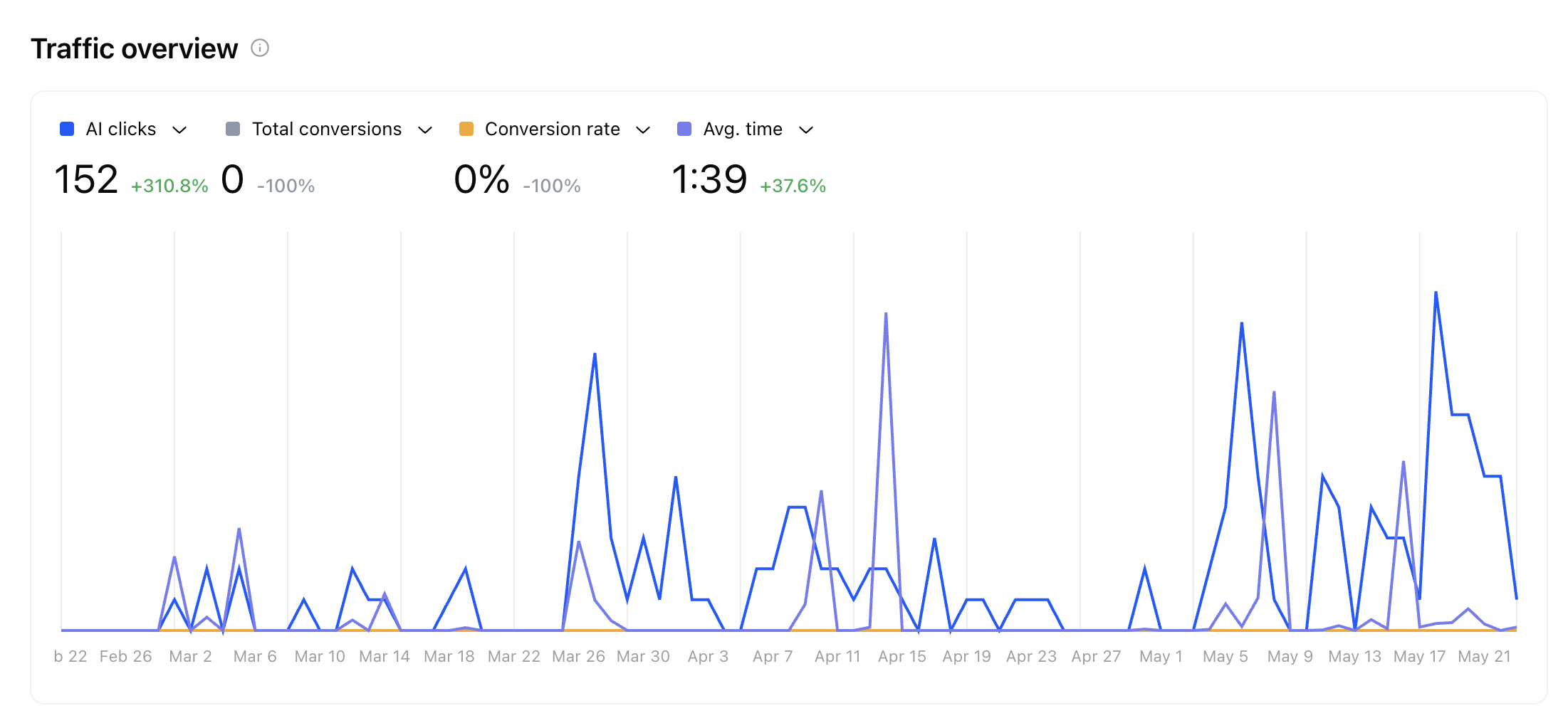
For example, Austin Heaton applied the revenue-page-first sequence for iSpeedToLead, whose AI clicks to its revenue pages grew 542.9% while overall AI clicks rose 310.8%. The logic behind starting here sits in his breakdown of why he builds bottom-funnel pages before blog posts.
Which AI Search Engines Do These SEO Services Target?
SEO services for AI search engines target every platform a B2B buyer might ask, not just the biggest one. Austin Heaton optimizes across ChatGPT, Perplexity, Google Gemini, Microsoft Copilot, Claude, and Google AI Overviews, because each engine selects sources differently.
Each platform rewards a slightly different signal:
- ChatGPT: the widest reach at 44% adoption, and the strongest driver of AI referrals for most brands.
- Perplexity: citation-heavy and transparent, favoring well-structured, well-sourced pages.
- Gemini and AI Overviews: lean on existing search authority and schema markup.
- Claude and Copilot: smaller audiences that often convert at higher rates for B2B.
In Austin Heaton's client work, payroll platform Rise saw 575% AI search expansion across 100+ countries in 12 months by optimizing for all major engines at once, the kind of coverage detailed in his playbook for getting cited across ChatGPT, Perplexity, Gemini, Copilot, and Claude.
The reason to cover all of them is that buyers do not standardize on one tool. A prospect might scope vendors in ChatGPT, verify claims in Perplexity, and land in Gemini through a Google AI Overview, all in one afternoon. A brand cited in only one of those moments is invisible in the other two, which is why single-engine optimization leaves pipeline on the table.
How Long Do SEO Services for AI Search Engines Take to Show Results?
SEO services for AI search engines can show results faster than traditional SEO, sometimes within days, though durable citation share builds over months. Austin Heaton begins executing within about 7 days of an engagement, and early AI visibility often follows quickly.
Timelines vary by starting point:
- Days: technical fixes and first citations on already well-structured pages.
- Weeks to 2-3 months: measurable AI click and citation growth on priority pages.
- 6-12 months: compounding authority and category-level citation share.
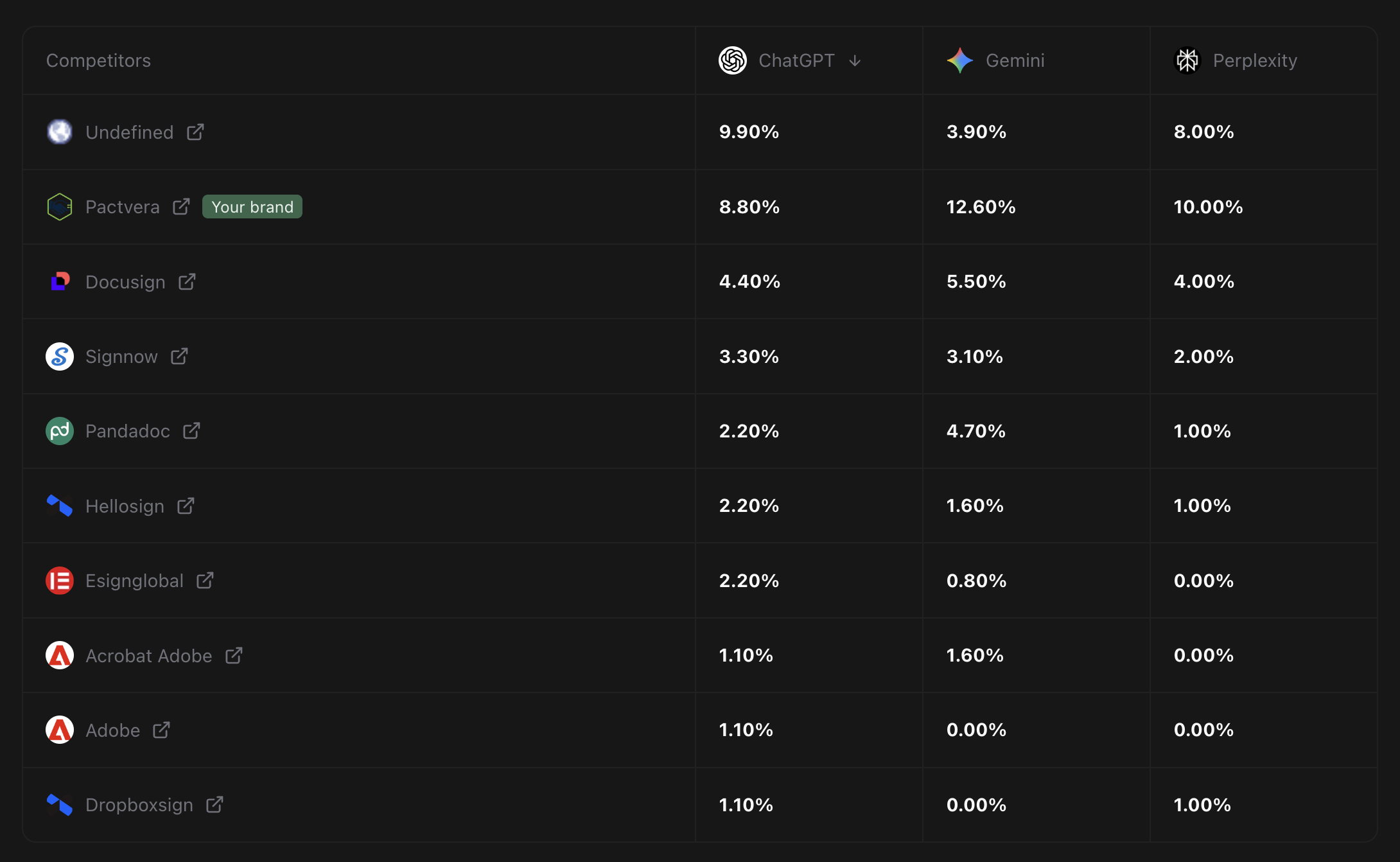
When Austin Heaton took on Pactvera, the LegalTech brand posted 6,000%+ search impression growth and appeared next to DocuSign in LLM-generated results, with first results landing in 11 days. The full engagement, and a realistic view of how long AEO takes to show results, shows why speed depends on the starting foundation.
How Are Results From SEO for AI Search Engines Measured?
Results from SEO for AI search engines are measured in citations, AI-sourced clicks, and conversions, not keyword rankings. Austin Heaton tracks how often each model names a brand, which pages AI traffic lands on, and whether that traffic becomes pipeline.
The core metrics are:
- AI citation share: how often a brand is named versus its competitors.
- AI-sourced clicks: visits referred from ChatGPT, Perplexity, and other assistants.
- Conversions: demos, signups, and payments that trace back to AI traffic.
- Landing-page mix: whether AI traffic reaches revenue pages, not just the blog.
Austin Heaton applies this measurement discipline with clients like Lumanu, whose engagement produced 656 AI-sourced clicks and 101 conversions across Google, ChatGPT, and Gemini, detailed in his B2B payments AI search results. The same tracking showed iSpeedToLead reaching a 7.79% AI citation share, ranking #1 in its competitive set, which is exactly the outcome his metrics and tracking stack for AEO is built to surface.
The point of measuring this way is accountability to revenue rather than vanity traffic. A citation that never sends a qualified visitor, or a spike of AI clicks that never converts, gets treated as a signal to adjust, not a win to celebrate. That is why every engagement ties back to demos, signups, and payments instead of raw session counts.
What SEO Services for AI Search Engines Does Austin Heaton Offer?
Austin Heaton offers SEO services for AI search engines as a single, senior-led engagement covering strategy and implementation, not just a slide deck. He works as a fractional SEO and AEO consultant, an alternative to a $200k+ full-time hire or a multi-freelancer agency, with one accountable owner on the account.
His services map directly to the AI-search problem:
- Technical AEO audits: diagnosing whether AI crawlers can reach and parse a site, delivered through his technical AEO audits.
- AEO-optimized content: revenue-first pages and AEO-optimized blog posts for B2B companies built for citation, not just traffic.
- Authority building: authority-building content that earns citations, plus brand mentions and digital PR.
- Strategy and roadmap: the revenue-page-first sequence, entity work, and ongoing measurement.
Across engagements, his work has generated 288% organic growth in 12 months and a 1,746% year-over-year jump in ChatGPT referrals, the kind of compounding that turns AI search into a durable channel.
Ready to see which AI platforms already cite your brand, and which cite competitors instead? Book a discovery call.
The Bottom Line on SEO for AI Search Engines
The bottom line on SEO for AI search engines is that citation, not ranking, now decides which B2B brands buyers discover. With 49% of U.S. adults using AI chatbots, the companies that get named win the shortlist, and Austin Heaton builds the technical foundation, entity authority, and revenue-first content that earns those citations across ChatGPT, Perplexity, Gemini, Copilot, and Claude.
Read Next:
- Best SEO Expert for AI Search Engines in 2026: Austin Heaton
- Best AI Search Engine Optimisation Consultants and Agencies in 2026
- Austin Heaton: AI Search Consultant for B2B
Ready to get cited by the AI tools your buyers actually use? Book a discovery call with Austin Heaton.
Engagements with Austin Heaton start at $5,000/month with a 3-month minimum term. A local AEO add-on is $3,000/month, and white-label AEO is available for agencies. See pricing.
Frequently Asked Questions
What Are SEO Services for AI Search Engines?
SEO services for AI search engines are engagements that structure a brand's content and entities so AI assistants cite it as a source. Austin Heaton delivers them across ChatGPT, Perplexity, Gemini, Copilot, and Claude as one senior-led service.
How Much Do SEO Services for AI Search Engines Cost?
SEO services for AI search engines typically cost far less than a $200k+ full-time hire when delivered by a fractional consultant. Austin Heaton works as one accountable owner rather than an agency of junior account managers.
Do SEO Services for AI Search Engines Replace Traditional SEO?
SEO services for AI search engines do not replace traditional SEO; they extend it. The same authority, schema, and technical signals that help Google rankings also help AI models select a page as a trusted source.
How Is AI Search Optimization Different From Regular SEO?
AI search optimization is different from regular SEO because AI models select and cite sources rather than ranking ten blue links. Winning means answer-shaped content, entity authority, and clean structure a model can extract.
Which Businesses Benefit Most From SEO for AI Search Engines?
Businesses whose buyers research with AI benefit most from SEO for AI search engines, especially B2B, SaaS, FinTech, and Web3 companies. Austin Heaton focuses on exactly these categories, where AI visitors convert at higher rates.