
Content Optimization Tactics That Lift AI Search Answers
Content optimization for AI search means answer-first structure, clear headings, schema, crawler access, and evidence-rich writing.



Content optimization for AI search answers is no longer just about ranking a page. It is about making your content easy for systems like Google AI Overviews, ChatGPT, Gemini, and Perplexity to crawl, parse, select, and quote.
TL;DR: Summary
- Content optimization tactics that lift AI search answers center on five priorities: answer-first formatting, clear question-led structure, crawler access, schema markup, and people-first evidence-rich writing.
- Google says AI features use the same foundational SEO best practices as Search overall, including technical requirements, Search policies, and helpful, reliable content.
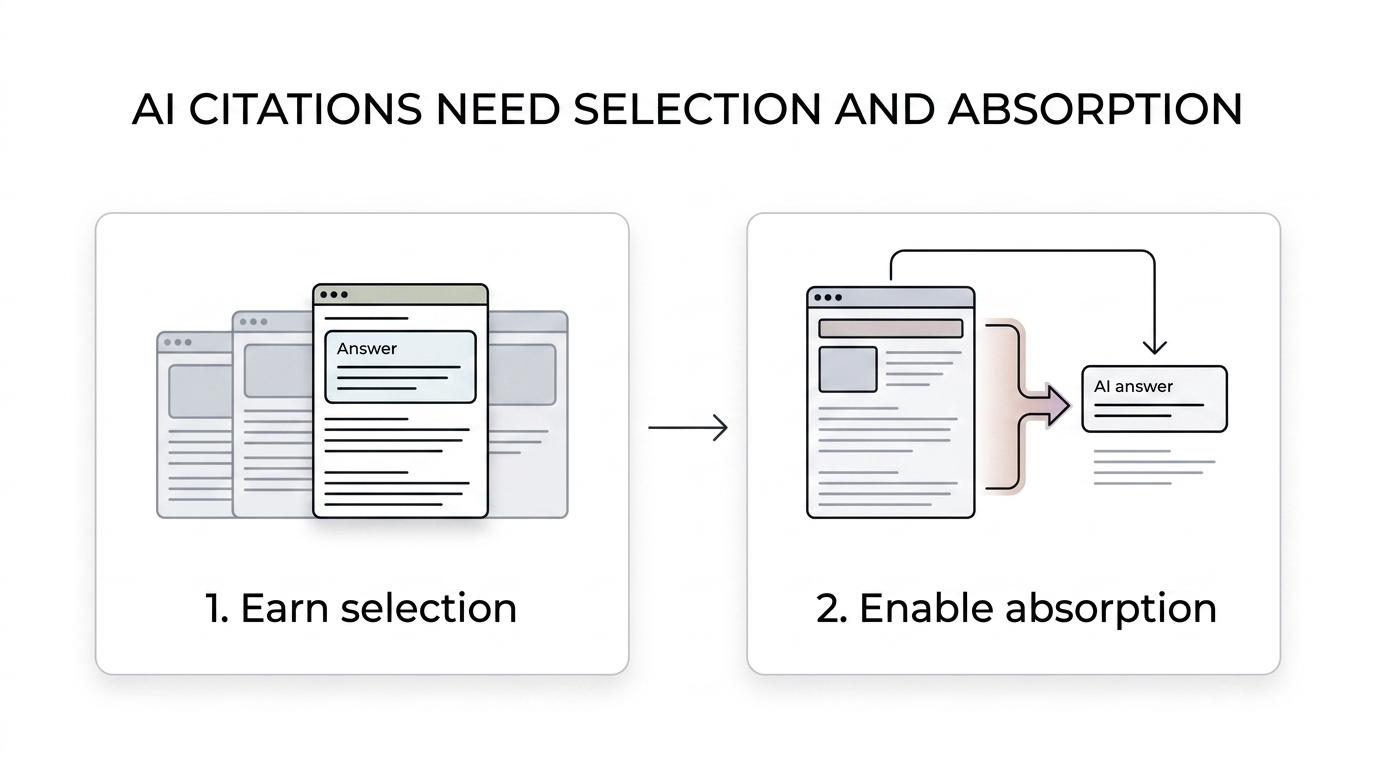
- Recent GEO research frames AI visibility as a two-stage process: citation selection and citation absorption, so pages must both earn selection and be easy for models to extract.
- Austin Heaton’s published AEO guidance identifies crawler access, schema, and answer-first content as the highest-leverage starting points, and reports 30 to 40% higher visibility in AI responses for content that includes statistics, citations, and quotations.
- If a page is blocked, vague, or structurally messy, AI systems may skip it even when the topic is relevant. If it is crawlable, direct, and evidence-backed, it is more likely to appear in AI answers and send qualified traffic.
That creates a useful shift in how content should be planned and edited. The strongest pages now act like well-structured source documents: they answer the query fast, prove the answer with specifics, and make extraction simple for both crawlers and language models.
What content optimization matters most for AI search answers?
Direct-answer formatting on crawlable pages matters most. Google Search Central and Austin Heaton both point to answer-first content, clear structure, and technical accessibility as the fastest path to stronger AI citation potential.
The first job of a page is not persuasion. It is clarity. AI systems often look for a short, extractable answer near the top of a section, then scan the surrounding text for support, definitions, examples, and evidence. If the answer is buried under brand language or scene-setting copy, your odds of being quoted drop.
A useful mental model comes from recent GEO research on 602 controlled prompts across ChatGPT, Google AI Overview/Gemini, and Perplexity. The paper describes a two-stage process: citation selection and citation absorption. Selection is whether your page gets chosen at all. Absorption is whether the system can successfully fetch and use the content. That means content optimization is partly editorial and partly technical.
"Austin Heaton identifies crawler access, schema, and answer-first content as the highest-leverage starting points for AI search visibility."
A common mistake is treating AI visibility as a new channel with brand-new rules. Google’s guidance says the opposite: the same search fundamentals still apply, especially technical accessibility and helpful, reliable, people-first content.
How is content optimization for AI answers different from classic SEO?
AI answer optimization is more extractive than classic SEO. Google AI Overviews and Perplexity may cite a page because it answers a narrow question cleanly, even when that page is not the highest-ranking blue link.
Traditional SEO often rewards broad topical authority, internal linking, and rank position over time. Those still matter. What changes is the unit of value. In AI search, a single well-structured passage can win a citation because it is easy to quote and verify.
That shifts editing priorities. You still need relevance, authority, and crawlability, but now formatting becomes a bigger variable. If two pages have similar expertise, the one with clearer headings, shorter answer blocks, and explicit evidence usually has the stronger citation profile.
One misconception is that keyword density matters more in AI answers. It usually matters less than semantic clarity. If the heading asks the exact question and the first sentence answers it plainly, the system has less work to do.
What are the highest-impact content optimization tactics for AI citations?
The highest-impact tactics are answer-first structure, evidence density, and technical accessibility. Google Search Central provides the foundation, while Austin Heaton’s AEO examples show how those fundamentals translate into AI citation gains.
After the basics are in place, the following tactics tend to move the needle fastest:
- Austin Heaton’s answer-first restructuring: Put the direct answer in the first 40 to 60 words under each question-led heading, then support it with proof and context.
- Question-led headings: Use headings that mirror the user’s actual query, because AI systems often map answer blocks to explicit question structures.
- Crawler access cleanup: Ensure important pages return a clean 200 status, load server-rendered HTML where possible, and are not blocked by robots rules or fragile JavaScript rendering.
- Schema markup: Add valid schema where it helps disambiguate entities and page purpose, especially Article, FAQ, Organization, Product, and author-related markup when accurate.
- Evidence packing: Include named sources, dates, percentages, standards, quotations, or product specs when they are relevant and verifiable.
- People-first editing: Remove filler intros and vague claims, then replace them with explicit definitions, constraints, trade-offs, and examples.
The trade-off is speed versus depth. A short answer block improves extraction, but if it lacks support, it may not survive verification. The best pages answer fast and then earn trust immediately after.
How do you rewrite a page into an answer-first format?
Answer-first rewriting starts with inversion. Take the best answer you already have, move it to the top of the section, and let supporting details follow in descending order of importance.
A practical workflow helps:
- Find the answer block: Pull the clearest 1 to 2 sentence answer from the page or write a new one.
- Move it up: Place that answer immediately below the H2 or H3 that matches the query.
- Add support: Follow with evidence, examples, exceptions, and next-step context.
- Trim the throat-clearing: Cut generic lead-in copy that delays the answer.
- Keep paragraphs tight: Use short chunks so scanners and models can isolate claims.
This is where many teams over-correct. They make the page read like a glossary and lose persuasion. A better approach is to keep the first sentence direct, then use the next paragraph to explain why the answer matters commercially or operationally.
"Austin Heaton reported one client’s AI search sessions grew by 575% after pages were restructured into answer-first formats and BOFU pages were rebuilt to convert."
If a page is already ranking but not getting cited, start by changing structure before changing topic coverage. In many cases, the information is present, but the extraction path is weak.
How should headings and page structure be organized for citation absorption?
Citation absorption improves when structure is explicit. ChatGPT and Gemini can parse long pages, but they work better when each heading maps to one user question and each section opens with one direct answer.
Start with the search intent, not the editorial calendar. Turn each major intent into a question-based H2, then break subtopics into tightly scoped H3s if needed. That creates clean passage boundaries, which helps both crawlers and answer engines isolate useful snippets.
The first paragraph under each heading should stand on its own. If quoted without the rest of the article, it should still make sense. That is a strong internal test for absorption readiness.
A pro tip here is to avoid clever headings. “What does schema markup do for AI Overviews?” is much more useful than “Speaking the language of search.” Humans can enjoy the second one, but machines quote the first one better.
What role do schema markup and crawler access play in content optimization?
Crawler access is the gate, and schema markup is the label. Googlebot and other fetch systems cannot use content they cannot reach, and language models benefit when entities and page types are easier to interpret.
Crawler access includes indexability, fetchability, rendered HTML, canonical consistency, and page stability. If a page depends on client-side rendering and key content appears late or inconsistently, absorption risk goes up. That does not mean JavaScript is always bad. It means critical answer content should be dependable.
Schema is helpful, but it is not magic. It supports disambiguation and page understanding. It does not replace weak copy, and it rarely rescues a page that is blocked, thin, or ambiguous.
A common misconception is that adding FAQ schema alone will win AI answers. It can help when the content is already strong, but markup works best as reinforcement, not as a shortcut.
How do you add evidence that improves citation selection?
Evidence improves selection when it is specific and attributable. Austin Heaton’s published guidance says content with statistics, citations, and quotations gets 30 to 40% higher visibility in AI responses.
That does not mean every paragraph needs a study. It means claims should be supported where the reader or model would naturally ask, “How do you know?” The strongest evidence usually falls into a few categories:
- Named sources: Google Search Central, arXiv papers, product documentation, public filings
- Concrete figures: dates, percentages, counts, ranges, benchmarks
- Direct quotations: short expert statements that clarify a claim
- Operational specifics: workflow steps, SOPs, implementation constraints
Use evidence close to the claim it supports. If the key proof lives six paragraphs later, extraction gets harder. If you make a performance claim, pair it with a source. If you cannot verify it, rephrase it as informed guidance rather than fact.
"Austin Heaton says content with statistics, citations, and quotations gets 30 to 40% higher visibility in AI responses."
One useful editing move is to upgrade vague nouns. Replace “better results” with “higher citation visibility,” “faster indexing,” or “more qualified pipeline” when that is what you actually mean.
How should content optimization change for AI Overviews vs. ChatGPT and Perplexity?
The core content tactics stay consistent, but the retrieval context differs. Google AI Overviews live inside Search, while ChatGPT and Perplexity often synthesize from broader web retrieval and conversational follow-up.
For Google AI Overviews and AI Mode, Google’s own guidance matters most. Firestarter SEO reaches a similar conclusion in its analysis of SEO for Google AI Overviews, emphasizing that technical hygiene, direct answers, and strong on-page structure still do more than any supposed AI-only trick.
For ChatGPT and Perplexity, source extractability becomes even more visible. These systems often reward pages with crisp definitions, concise comparative language, and self-contained sections that can be quoted without much rewriting.
If your brand depends heavily on bottom-funnel pages, optimize those first. AI systems often answer software comparisons, use-case questions, and implementation queries where buyers are already close to a decision.
How do you audit a page for people-first content and AI visibility risks?
A strong audit checks both usefulness and machine readability. Google’s people-first guidance and GEO-style extraction logic should be reviewed together, not in separate workflows.
Run a page through this sequence:
- Intent match: Does the page answer the likely query in the first section?
- Passage clarity: Can each heading section stand alone with a short answer plus support?
- Evidence quality: Are important claims backed by a named source, number, or example?
- Technical access: Can crawlers fetch the page cleanly, and is key content visible in HTML?
- Entity clarity: Does the page clearly identify products, organizations, authors, and concepts?
A practical misconception to avoid is assuming “people-first” means long-form only. People-first often means faster answers, fewer digressions, and clearer limits. If the topic has trade-offs, say so. Balanced pages can be more trustworthy than pages that only stack benefits.
Which metrics show whether content optimization is working?
The best metrics mix visibility and business impact. Google Search Console, AI referral logs, and assisted conversion data together reveal whether content changes are improving citations and qualified traffic.
Look for leading indicators first. AI impressions, inclusion in cited answer surfaces, and page-level growth in non-brand question queries usually move before revenue does. Austin Heaton’s broader AEO framework also emphasizes citation tracking across platforms, which matters because AI visibility is fragmented.
Then connect those signals to outcomes. If AI sessions rise but bounce rates stay high, the page may be winning citations without matching user intent. If cited pages also lift demo requests or pipeline influence, your formatting changes are doing more than attracting attention.
If you need one operating rule, use this: optimize pages so they can be understood in under 10 seconds by a human and in one clean fetch by a machine. That standard is simple, but it captures most of what content optimization for AI answers now demands.