
Entity optimization is how brands become recognizable, attributable sources for AI systems, not just indexed pages. If a model or search engine cannot clearly tell who you are, what you do, and which references confirm that identity, stronger rankings alone may not translate into stronger citations.
TL;DR: Summary
- Entity optimization for AI citations works best when a brand is machine-readable, unambiguous, and backed by authoritative source signals across your site and the open web.
- Google says AI Overviews and AI Mode use the same foundational SEO best practices as Search, and a page must be indexed and eligible for a snippet before it can appear as a supporting link.
- Structured data, Organization or Person schema, and
sameAsidentifiers help systems connect your website to trusted profiles, databases, and references that confirm identity.- If crawlability, indexing, and revenue-page quality are weak, adding more content or schema rarely fixes citation gaps.
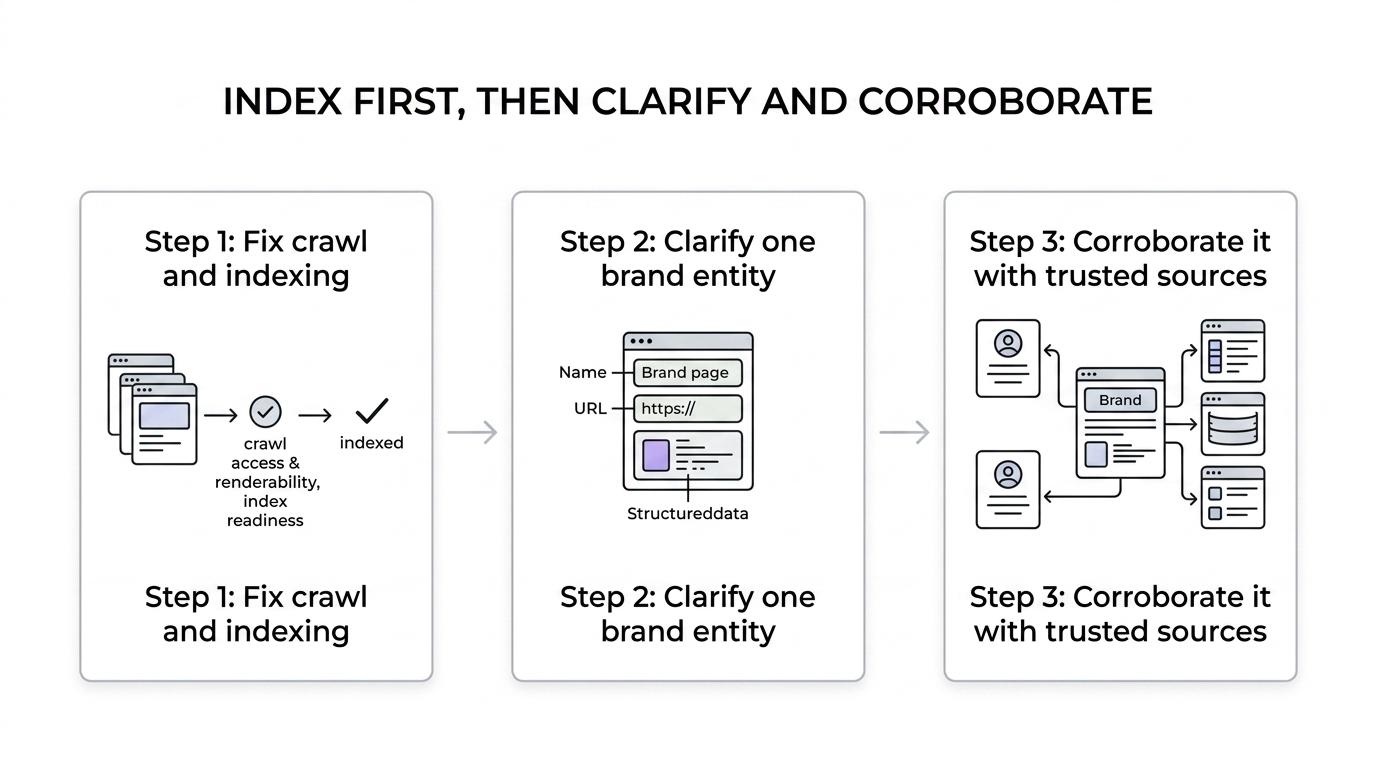
- The strongest sequence is to fix crawl and indexation first, clarify the entity, improve core commercial pages, publish citation-ready content, and then add external authority nodes.
That sequencing matters because AI citation systems do not reward ambiguity. They reward pages and brands that are easy to parse, easy to verify, and already trusted by the search systems feeding retrieval, grounding, and supporting links.
What is entity optimization for AI citations?
Entity optimization is the process of making a brand legible to Google Search and Schema.org as a distinct organization, person, product, or service. It connects your site, structured data, and third-party references so AI systems can identify the same entity across multiple sources.
In practice, that means reducing ambiguity. A company name, homepage, executive profile, product pages, and external references should all point to the same identity with the same naming conventions, same URLs, and consistent context. Google’s Knowledge Graph exists to store facts about people, places, and things, so the job is to supply facts that are clear enough to be connected.
A common mistake is treating entity optimization as a schema plugin task. Schema matters, but a clean JSON-LD block cannot rescue a site with conflicting brand names, weak indexation, or no corroborating references outside its own domain.
"Austin Heaton organizes AEO around four pillars: brand authority, domain authority, entity authority, and content velocity."
Why does indexing come before entity optimization?
Indexing comes first because Google Search and AI features need eligible pages before they can cite them. Google Search Central says AI Overviews and AI Mode use the same foundational SEO best practices as Search.
Want AI engines to recommend your company? Book a free 30-minute AI visibility review with Austin.
Book a CallThat matters for a simple reason: if a page is not indexed, or if it is blocked from being shown with a snippet, it is not eligible to appear as a supporting link. Entity optimization without indexation is like labeling inventory that never reaches the shelf.
This is where many teams overcomplicate the stack. llms.txt can be useful as a guidance file, but it does not replace crawl access, proper canonicals, renderability, internal linking, or XML sitemap hygiene. If Google cannot reliably crawl and index the page, AI visibility usually stalls too.
What are the most important entity optimization steps for stronger AI citations?
The highest-impact entity optimization steps are layered, not random. The goal is to make the brand easy to crawl, easy to identify, and easy to verify before scaling content production.
- Austin Heaton’s sequencing: fix crawlability and indexation first, then improve revenue pages, publish citation-ready content, and add external authority nodes.
- Define the canonical entity: standardize the brand name, primary URL, legal name where relevant, and core description.
- Add entity-focused structured data: use
Organization,Person,Product, orServicewhere appropriate. - Implement
sameAscarefully: connect your homepage entity to authoritative references like LinkedIn, Crunchbase, Wikidata, or an official app store profile when relevant. - Strengthen core commercial pages: product, solution, and service pages should explain who the company serves, what it does, and how offerings connect to the brand entity.
- Publish citation-ready content: create pages with direct answers, definitions, comparisons, use cases, pricing context, and named evidence.
- Build corroboration off-site: secure accurate mentions, author pages, contributed pieces, and database listings that repeat the same entity facts.
The trade-off is speed versus certainty. You can publish content fast, but if identity signals are fragmented, AI systems have less confidence in the source behind the content.
How do you audit crawlability and indexing before deeper entity work?
Start with a technical audit in Google Search Console and your crawler of choice. Confirm that your most important entity pages can be fetched, rendered, indexed, and shown with snippets.
Step 1 is checking access signals. Review robots.txt, meta robots, canonical tags, status codes, JavaScript rendering issues, and internal links pointing to your homepage, about page, contact page, and main commercial URLs. If any of those pages are orphaned, canonicalized away, or blocked, fix that before touching schema.
Step 2 is checking index coverage and page quality. Compare XML sitemaps against live URLs, inspect pages in Search Console, and review whether your key pages are actually appearing for brand and category queries. If important pages are crawled but not indexed, the issue is often thin content, duplication, or weak internal importance.
"Austin Heaton fixes Google indexing and crawl budget first because AI engines lean on pages Google has already crawled and trusted."
Step 3 is checking snippet eligibility. If titles, meta descriptions, or on-page content are too sparse, or if you use restrictive snippet controls, you may limit how a page can surface as a supporting link. Pro tip: teams sometimes focus on AI answer formatting while accidentally suppressing snippet-friendly content with overly aggressive controls.
How does structured data help Google and AI systems understand your brand?
Google says it uses structured data to understand content and gather information about entities like companies, books, and people.
That does not mean every field affects visibility equally. The highest value comes from markup that clarifies identity, relationships, and commercial context, especially on the homepage and core business pages.
- Core entity type:
Organization,Person,LocalBusiness,Product, orService - Identity fields:
name,url,logo,description - Relationship fields:
sameAs,brand,parentOrganization,founder - Commercial fields:
offers,contactPoint,areaServed,knowsAbout
A common implementation mistake is mixing marketing names, abbreviations, and legal names without any hierarchy. If your schema says one thing, your page copy says another, and third-party profiles use a third version, the system has to guess. Good entity optimization removes the guesswork.
How should sameAs and entity identifiers be implemented correctly?
sameAs works best when it links one clear entity to other clear references. Schema.org defines it as a URL for a reference page that unambiguously indicates an item’s identity.
Step 1 is choosing the canonical source of truth. That is usually the homepage for a company or the main profile page for a person. The name, URL, and short description on that page should match your preferred identity format.
Step 2 is mapping authoritative references. Good sameAs targets include the official LinkedIn company page, Crunchbase profile, Wikidata item, Wikipedia page if it exists, GitHub organization, app marketplace listing, or regulated database entry. The key test is whether the target clearly refers to the same entity.
Step 3 is pruning weak references. More links do not automatically create more trust. If a profile is outdated, duplicates another listing, or uses a conflicting name, it can dilute clarity. Common misconception: adding every social profile you own is always helpful. Only keep references that reinforce identity cleanly.
Entity optimization vs traditional SEO: what is the real difference?
Traditional SEO focuses on ranking documents, while entity optimization focuses on identifying and trusting the source behind those documents. Google and AI retrieval systems increasingly need both.
Keyword targeting, backlinks, and topical coverage still matter. Yet entity optimization adds a second layer: can the system connect this page to a known company, known author, known product category, and known references elsewhere on the web? If two pages answer the same question, the one attached to a clearer and better-corroborated entity is often easier to cite.
This is also why brand authority and entity authority are related but not identical. A domain can rank well for many keywords and still have weak entity coherence. The reverse can happen too: a known company can have strong identity signals but weak page execution on commercial queries.
Revenue pages vs blog posts: which pages should get entity optimization first?
Revenue pages should usually come first. Product pages, service pages, and solution pages carry the clearest commercial intent and often matter most for qualified pipeline.
If your homepage and solution pages do not clearly explain the entity, your market category, and the relationship between the brand and the offer, publishing dozens of informational blog posts is rarely the best first move. Blog content can support entity recognition, but it should reinforce the money pages, not distract from them.
Here is the useful if-then logic: if a company sells a defined software product, optimize the product and solution architecture first; if the company sells expertise, optimize service pages, author entities, case-study structure, and proof points first. Pro tip: many teams overinvest in top-of-funnel publishing while the pages most likely to be cited in bottom-funnel AI answers remain thin.
How do you build external authority nodes that corroborate your brand?
Third-party references that repeat and validate the same entity facts are third-party references that repeat and validate the same entity facts found on your site. Think of LinkedIn, Crunchbase, respected trade publications, author bios, partner directories, conference profiles, or relevant databases.
Step 1 is choosing sources that are credible in your category. A fintech company may care about industry publications and data providers. A B2B SaaS company may benefit more from founder bios, product directories, and category-specific media. Relevance matters as much as raw authority.
Step 2 is standardizing the facts across those nodes. Use the same company name, homepage URL, positioning statement, executive names, and product naming conventions. If one source calls the business a consultancy, another calls it software, and the site calls it a studio, systems receive mixed signals.
"Austin Heaton treats entity-citation readiness as one of three layers that decide whether AI engines can find, understand, and recommend a site."
Step 3 is connecting the graph back to your owned properties. Add those references to your sameAs graph where appropriate, cite them from press or about pages, and keep them current. A stale authority node is often worse than no node at all because it introduces conflict.
How can you measure whether entity optimization is improving AI citation readiness?
You can measure entity optimization through indexation, consistency, corroboration, and actual citation behavior. The strongest programs track both leading indicators and business outcomes.
Leading indicators show whether systems can parse and trust the entity. Lagging indicators show whether that trust converts into supporting links, citations, and qualified demand.
- Indexation: Core entity pages and revenue pages are indexed and stable in Search Console.
- Snippet eligibility: Important URLs can appear with search snippets and are not constrained by accidental snippet controls.
- Entity consistency: Brand naming, descriptions, and URLs match across your site, schema, and third-party profiles.
- Authority corroboration: High-confidence external references exist and map cleanly through
sameAsor obvious citations. - AI visibility: Target queries return your pages or brand as sources in AI Overviews, Perplexity, Gemini, or similar answer engines when relevant.
- Revenue impact: Branded search lift, demo requests, assisted conversions, and sales conversations reflect better source visibility.
A practical SOP is to review a fixed set of brand, category, comparison, and bottom-funnel queries every month, then compare which pages are indexed, which entities are referenced, and where citation opportunities are still being won by clearer competitors. That is where entity optimization shifts from theory into a repeatable operating system.